In Reading Boots Episode 006, you will learn the Retelling Beginning, Middle, & End Comprehension Strategy. In this “after” reading strategy, your child gets the very important job of retelling what happened in the beginning, middle, and end of a story you read out loud.
Retelling the beginning, middle, and end helps your child organize their thoughts in order and remember what was in the story. Your child will love having the important job of retelling!
What’s in the video
- 0:00 Introduction to strategy
- 0:53 Preparing for the activity
- 1:55 Visualizing the narrative
- 2:45 Retelling the story
- 3:55 Conclusion and benefits
Read the full transcriptHide the transcript
"Oh, while we were reading, I forgot what happened in Goldilocks and the Three Bears, so I'm gonna need your help."
Howdy, Alyse here. Thanks for tuning in to Reading Boots, and thanks for taking the time to learn something new for your child. Today I have a very important after reading strategy that I'm going to teach you. Today's strategy is a comprehension strategy that helps your child retell the beginning, middle, and end of a story that you read out loud.
The reason that retelling beginning, middle, and end is so important is because it helps your child organize his or her thoughts in a sequential order and helps your child remember what was in the story.
To kick off the retelling beginning, middle, and end strategy, I'm going to use Goldilocks and the Three Bears. Tell your child before you read the story that you're gonna play a game called Beginning, Middle, and End, and your child is going to have the very important job of retelling what happened at the beginning, middle, and end of the story. You want to tell your child before you read that he or she will be retelling the story, because it will help your child get prepared and help your child pay more attention during the reading.
So you'll have read the story out loud, and then it will be time to use the beginning, middle, and end strategy. A fun way to do this, and something I like to do with my students, is pretend that I forgot what happened in the story and that I really need their help to piece the story back together. So you can say something like, "Oh my goodness, you won't believe this. While we were reading, I forgot what happened in Goldilocks and the Three Bears, so I'm gonna need your help."
I like to get out a whiteboard. You can use a whiteboard or a piece of paper and draw a line and have three dots for beginning, middle, and end. I also write out the B for beginning, M for middle, and E for end. This helps your child have a visual model of what he or she is going to be retelling.
You'll have your story, and you want your child to look back at the story if necessary, and you can even reread parts of the story, because you want your child to be successful retelling the beginning, middle, and end.
You'll say, "Can you tell me what happened at the beginning of the story?" And so your child would say, "In the beginning, the three bears went out for a walk." And you'll say, "Wow, thank you for giving me that information," and you'll repeat what happened.
And then you'll ask, "Can you tell me what happened in the middle of the story?" And your child will say, "In the middle of the story, Goldilocks walked into the three bears' house and ate their food and sat on their chairs and slept in their bed." And then you'll repeat it back so that your child hears what he or she said happened.
And then you'll go to the end and ask your child, "Can you tell me what happened at the end of the story?" And your child will say, "At the end of the story, the three bears came home and scared Goldilocks, and she ran away and never came back." And you'll repeat.
After your child has told you what happened in the beginning, middle, and end, you'll want to retell the story back to your child and say, "In the beginning," and go right into "In the middle," and go right into "In the end," and you'll retell it just like a story. Also want to make sure to say, "Wow, now I know what happened in the story. Thank you so much for doing a great job retelling the beginning, middle, and end."
You can do this with any read aloud that has a good beginning, middle, and end. This is a very, very important strategy that your child will be asked to do for his or her entire life. Modeling and practicing early will get him or her off to a great start. Thanks for tuning in. Get your Reading Boots on and enjoy the read aloud journey.
Free Beginning, Middle, and End Worksheet
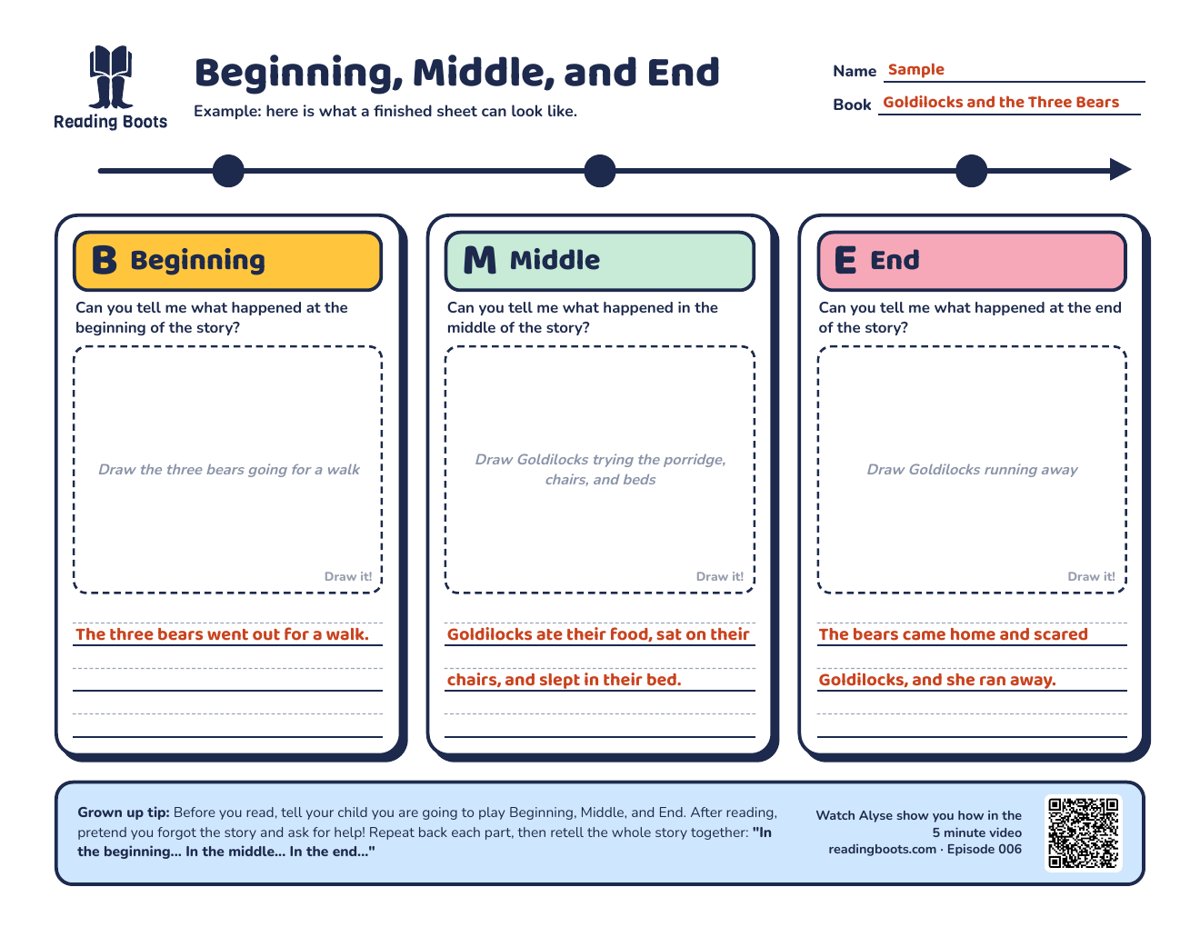
Print this free worksheet to play Beginning, Middle, and End at home. It has the same line with three dots I use on my whiteboard, a box to draw each part, and lines to write. Page 2 is a filled in Goldilocks example.
Find more on our Free Printables page.
How to play beginning, middle, and end
- Tell your child about the game before you read. Say that you are going to play a game called Beginning, Middle, and End, and that they will have the very important job of retelling the story. Knowing this ahead of time helps your child pay more attention while you read.
- Read the story out loud. Enjoy the read aloud together.
- Pretend you forgot! This is my favorite part, and my students love it. Say something like, “Oh my goodness, you won’t believe this. While we were reading, I forgot what happened in Goldilocks and the Three Bears, so I’m going to need your help!”
- Draw a simple picture of the story. On a whiteboard or a piece of paper, draw a line with three dots. Write B under the first dot for beginning, M for middle, and E for end. This gives your child a visual model of what they are going to retell.
- Ask about each part, one at a time. Ask, “Can you tell me what happened at the beginning of the story?” Then the middle, then the end. After each answer, say thank you and repeat back what your child said, so they hear it again.
- Look back at the book when needed. Your child can look back at the pages, and you can even reread parts. You want your child to be successful.
- Retell the whole story back. Put it all together like a story: “In the beginning… In the middle… In the end…”
- Say thank you. “Wow, now I know what happened in the story! Thank you so much for doing a great job retelling the beginning, middle, and end.”
Questions to ask
- Can you tell me what happened at the beginning of the story?
- Can you tell me what happened in the middle of the story?
- Can you tell me what happened at the end of the story?
If your child needs a little more help, try: Who was in the story? What was the problem? How did it work out?
Example: Goldilocks and the Three Bears
Here is how a retelling sounds in the video.
- Beginning: The three bears went out for a walk.
- Middle: Goldilocks walked into the three bears’ house, ate their food, sat on their chairs, and slept in their bed.
- End: The three bears came home and scared Goldilocks, and she ran away and never came back.
Short answers are perfect. One sentence for each part is a wonderful start.
Tips by age
Ages 3 to 4: Keep it short and lean on the pictures. You can start the sentence and let your child finish it: “At the beginning, the three bears went out for a…”
Ages 5 to 6: Use the line with three dots every time, and let your child point to each dot as they retell. Ask for one more detail in each part.
Ages 7 to 8: Ask for more detail, like character names, the problem, and how it was solved. Your child can draw or write one sentence for each part, or retell a chapter of a longer book.
The book from this episode

Goldilocks and the Three Bears
A classic fairy tale with bright, colorful pictures. Children will love joining in with the three bears, and it is a perfect story for practicing beginning, middle, and end.
Find it on AmazonFrequently Asked Questions
What is the beginning, middle, and end strategy?
It is an after reading strategy where your child retells what happened at the beginning, middle, and end of a story you read out loud. It helps your child organize their thoughts in order and remember what was in the story.
Why should I tell my child about retelling before we read?
When your child knows they will have the important job of retelling, it helps them get ready and pay more attention while you read.
What if my child can’t remember part of the story?
That is okay! Look back at the pages together, and even reread parts of the story. You want your child to be successful retelling the beginning, middle, and end.
What books work best for retelling?
You can do this with any read aloud that has a good beginning, middle, and end. Fairy tales like Goldilocks and the Three Bears are a great place to start.
Why is retelling so important?
Retelling is a skill your child will be asked to use for their entire life. Modeling and practicing it early gets your child off to a great start with reading comprehension.
SUBSCRIBE to my YouTube channel to stay updated on when I post new tips, strategies, and tricks of the trade. Get your reading boots on and enjoy the read aloud journey!