
In Reading Boots Episode 007, you will learn how to select, introduce, and organize sight words. Sight words are words children need to know immediately, by sight, to become proficient readers. When sight words are selected, introduced, and organized in a systematic way, children learn them best.
New to sight words? Start with Episode 005, What Are Sight Words?
What’s in the video
- 0:00 Introduction
- 0:39 Sight Word Selection
- 1:53 Introducing Sight Words
- 2:49 Organizing Sight Words
Read the full transcriptHide the transcript
"That's one of our super special sight words."
Howdy, Alyse here. Thanks for tuning in to Reading Boots, and thanks for taking the time to learn something new for your child. Today I'm going to teach you how to select, introduce, and organize your child's sight words. Children need to know sight words immediately by sight in order to become proficient readers. When sight words are selected, introduced, and organized in a systematic way, children learn sight words best.
First off, sight word selection. How do you select the sight words you're going to introduce? What you'll need is your read aloud, and I'm going to use No, David! You'll need the sight word lists. I have a Dolch kindergarten sight word list. And you'll need a marker. What you'll do is you'll review the sight word list, and you'll also take a look at the words in the story. In this story, No, David!, we see the word "no" repeated quite a bit, and the word "no" is on the sight word list, so that's going to be one of my sight words that I would introduce. And in No, David! we also have the sight word "yes," which is on the kindergarten sight word list, so I'm also going to introduce the word "yes."
What you'll do next is you'll take your marker and you'll write the date next to the words that you're introducing. That's a great way to stay organized and to know what words you've already introduced.
What you're going to do with your child before you read is introduce the sight words that you selected. You will tell your child, "We're going to read No, David!, and in No, David! there are two very special sight words. The special sight words for No, David! are the word 'no' and 'yes.'" You'll open up the book and go on a word hunt with your child, and you can say, "That's one of our super special sight words. That's the word 'no.' Our other super special sight word is the word 'yes.' Let's look for the word 'yes.'" And you'll look through the pages and go on a hunt with your child. When you find the word "yes," you'll stop and say, "Wow, this is one of our special sight words. This is the special sight word 'yes.'" Now you've introduced the sight words to your child.
The last thing that you need to do is organize the sight words. A great way to organize your sight words and have them all in one place is to make a personal word wall for your child. What I've used is two manila folders, and I taped them together, wrote the child's name on the front, and created squares with lines for children to write the sight words. The best way to organize sight words is in alphabetical order.
The sight words I chose were the words "no" and "yes," so I'm going to start with the word "no" and look for the N, and now I'm going to write the word "no." When you do this with your child, you can write it with your child or have your child write it. My next word is "yes," so now I'm going to look for the Y, and I'm going to spell the word "yes." Now I have the two words I've introduced on my word wall, "no" and "yes."
And as you continue to teach your child sight words, you can practice them, find them in the book, and then add them to the word wall. Your child will feel very proud as he or she fills up the word wall with all different words that he or she knows and found in books.
Today I got down to basics on how to select, introduce, and organize sight words. In future episodes, I'll share some fun sight word games. If you want to learn more, go check out Episode 5, where I got down to the basics on sight words. Thanks for tuning in. Get your Reading Boots on and enjoy the reading journey.
Free Word Wall and Sight Words List
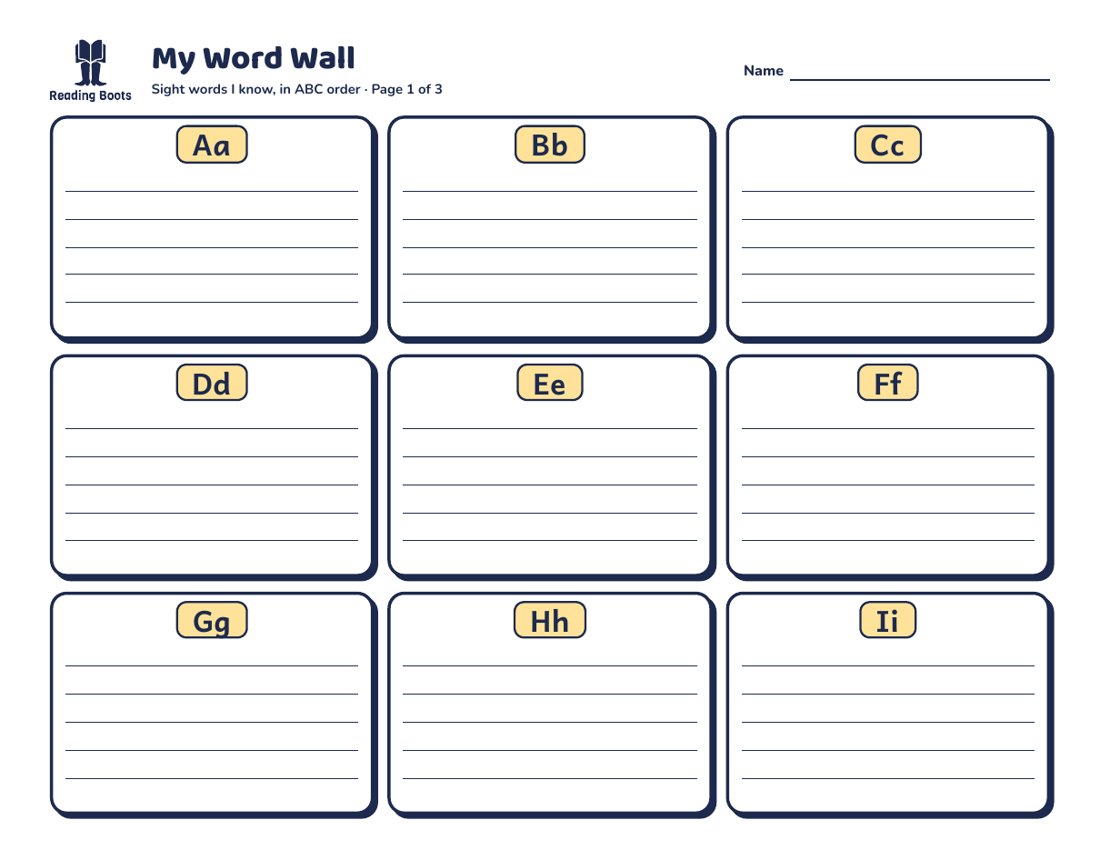
Print your child’s own word wall, with a box for every letter, A to Z. Tape the pages inside a file folder, and your child is ready to start adding words!
Pick your words from our free sight words list, with the Dolch Pre-Primer and Primer words:
What you’ll need
- Your read aloud book (I use No, David!)
- A sight words list
- A marker
- A word wall (two file folders taped together, or our printable)
Step 1: Select your sight words
Look at your sight words list and the words in your book. Choose words that are on the list and show up in the story. In No, David!, the word no is repeated again and again, and it’s on the kindergarten sight words list, so that’s a great word to introduce. The word yes is in the book and on the list too.
Write the date next to each word you introduce. It’s a great way to stay organized and know which words you have already taught.
Step 2: Introduce the words before you read
Before you read, tell your child: “We’re going to read No, David!, and there are two very special sight words in this book, no and yes.”
Then open the book and go on a word hunt together. When you find the word, stop and celebrate: “Wow, that’s one of our super special sight words! That’s the word no!” Then hunt for the next word the same way.
Step 3: Organize the words on a word wall
A personal word wall keeps all of your child’s sight words in one place. I tape two file folders together, write the child’s name on the front, and draw boxes with lines for each letter. Sight words are best organized in ABC order.
Find the first letter of the word, then write it in that box. You can write it with your child, or let your child write it. As you keep teaching new words, practice them, find them in books, and add them to the wall. Your child will feel so proud watching the word wall fill up with words they know!
Sight word games to try
- Word hunt. Go back to a favorite book and hunt for the words on the word wall.
- Word Power. Your child becomes a word magician in this fun after reading game. Learn how in Word Power, Episode 008.
- Read the wall. Point to each word on the word wall and read it together. Celebrate every word your child knows!
Tips by age
Ages 3 to 4: Start with just 1 word at a time, and keep the word hunt short and playful. You write the words on the wall while your child watches.
Ages 5 to 6: Introduce 1 or 2 words for each book from the Pre-Primer and Primer lists. Let your child try writing the words on the word wall.
Ages 6 to 8: Keep adding words as your child moves on to the next Dolch lists. Your child can find the words in books on their own and read the whole wall to you.
The book from this episode

No, David!
By David Shannon. David is always getting into trouble, and all he hears is “No, David!” Kids love his silly antics, and the ending is a sweet reminder that even on messy days, David is loved. The simple text is great for beginning readers.
Find it on AmazonFrequently Asked Questions
How many sight words should I teach at a time?
Start with 1 or 2 new words from the book you are reading. Practice them in books, add them to the word wall, and add new words when your child is ready.
What do I need to make a word wall?
Two file folders taped together, a marker, and boxes for each letter of the alphabet. Or print our free word wall and tape the pages inside a folder.
What if my child forgets a sight word?
That is completely normal! Go on another word hunt in a favorite book and read the word wall together. Seeing the words again and again in books helps them stick.
What are fun sight word games?
A word hunt in your read aloud is a great start. Try Word Power in Episode 008, where your child becomes a word magician, or write the words on cards and play a matching game.
SUBSCRIBE to my YouTube channel to stay updated on when I post new tips, strategies, and tricks of the trade. Get your reading boots on and enjoy the reading journey!